
%20--%3e%3csvg%20version='1.1'%20id='Layer_1'%20xmlns='http://www.w3.org/2000/svg'%20xmlns:xlink='http://www.w3.org/1999/xlink'%20x='0px'%20y='0px'%20viewBox='0%200%2030%2029'%20style='enable-background:new%200%200%2030%2029;'%20xml:space='preserve'%3e%3cstyle%20type='text/css'%3e%20.st0{fill-rule:evenodd;clip-rule:evenodd;fill:%23FFFFFF;}%20%3c/style%3e%3cg%20id='Symbols'%3e%3cg%20id='Footer'%20transform='translate(-468.000000,%20-360.000000)'%3e%3cg%20id='Group-5-Copy'%20transform='translate(468.000000,%20360.000000)'%3e%3cpath%20id='Fill-1'%20class='st0'%20d='M17.1,26.8h9.3c0.2,0,0.4-0.2,0.4-0.4V2.6c0-0.2-0.2-0.4-0.4-0.4H2.6c-0.2,0-0.4,0.2-0.4,0.4%20v23.8c0,0.2,0.2,0.4,0.4,0.4h12.3v-8.2h-3.3c-0.6,0-1.1-0.5-1.1-1.1s0.5-1.1,1.1-1.1h3.3v-4.8c0-2.3,1.8-4.1,4.1-4.1h3%20c0.6,0,1.1,0.5,1.1,1.1S22.6,9.7,22,9.7h-3c-1,0-1.9,0.8-1.9,1.9v4.8h3.3c0.6,0,1.1,0.5,1.1,1.1s-0.5,1.1-1.1,1.1h-3.3V26.8z%20M26.4,29H2.6C1.2,29,0,27.8,0,26.4V2.6C0,1.2,1.2,0,2.6,0h23.8C27.9,0,29,1.2,29,2.6v23.8C29,27.8,27.9,29,26.4,29L26.4,29z'/%3e%3c/g%3e%3c/g%3e%3c/g%3e%3c/svg%3e)

%20--%3e%3csvg%20version='1.1'%20id='Layer_1'%20xmlns='http://www.w3.org/2000/svg'%20xmlns:xlink='http://www.w3.org/1999/xlink'%20x='0px'%20y='0px'%20viewBox='0%200%2030%2030'%20style='enable-background:new%200%200%2030%2030;'%20xml:space='preserve'%3e%3cstyle%20type='text/css'%3e%20.st0{fill:none;stroke:%23FFFFFF;stroke-width:2;stroke-linecap:round;stroke-linejoin:round;}%20.st1{fill:none;stroke:%23FFFFFF;stroke-width:2.6;stroke-linecap:round;stroke-linejoin:round;}%20%3c/style%3e%3cg%20id='Symbols'%3e%3cg%20id='Footer'%20transform='translate(-568.000000,%20-360.000000)'%3e%3cg%20id='Group'%20transform='translate(569.000000,%20361.000000)'%3e%3cpath%20id='primary'%20class='st0'%20d='M20,22v-4.8c0-1.8-1.3-3.2-3-3.2l0,0c-1.7,0-3,1.4-3,3.2V22'/%3e%3cpath%20id='primary-2'%20class='st0'%20d='M26.4,28H1.6C0.7,28,0,27.3,0,26.4V1.6C0,0.7,0.7,0,1.6,0h24.9C27.3,0,28,0.7,28,1.6v24.9%20C28,27.3,27.3,28,26.4,28z%20M7.8,14v7.8%20M14,17.1V14'/%3e%3cline%20id='primary-upstroke'%20class='st1'%20x1='7.8'%20y1='8.5'%20x2='7.8'%20y2='8.1'/%3e%3c/g%3e%3c/g%3e%3c/g%3e%3c/svg%3e)
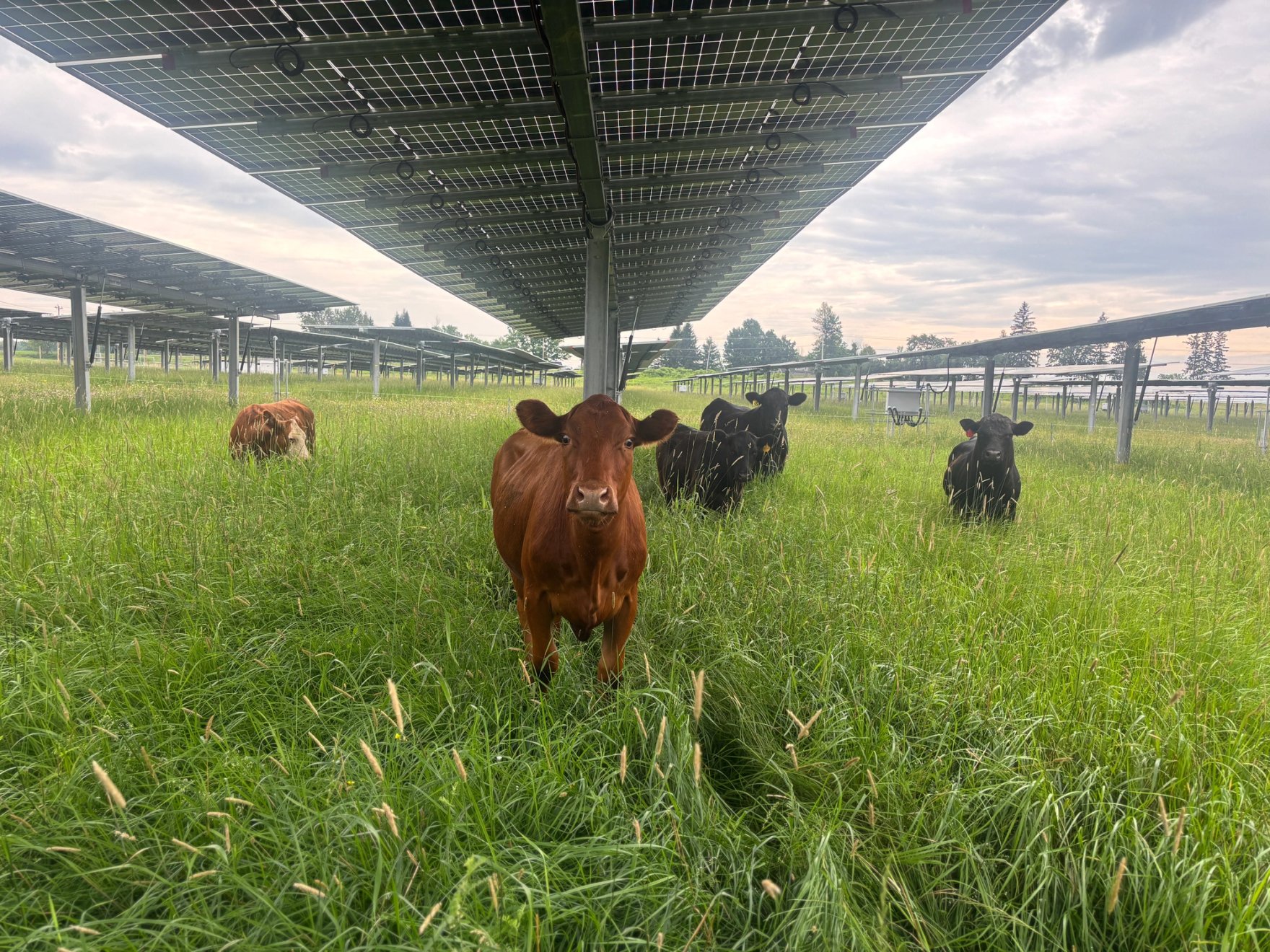
When Nexamp first tried solar grazing in 2018 at Newfield Solar in New York, it was a simple question with big potential: could livestock help maintain solar sites in a way that was better for the land, better for farmers, and better for the business? The answer, as it turned out, was yes.
Since then, our solar grazing program has grown steadily, nearly doubling each year. This season, we’re grazing approximately 90 sites across five states, covering more than 1,800 acres. What began as a pilot has become an important part of how we care for our solar assets and how we partner with local agricultural communities.
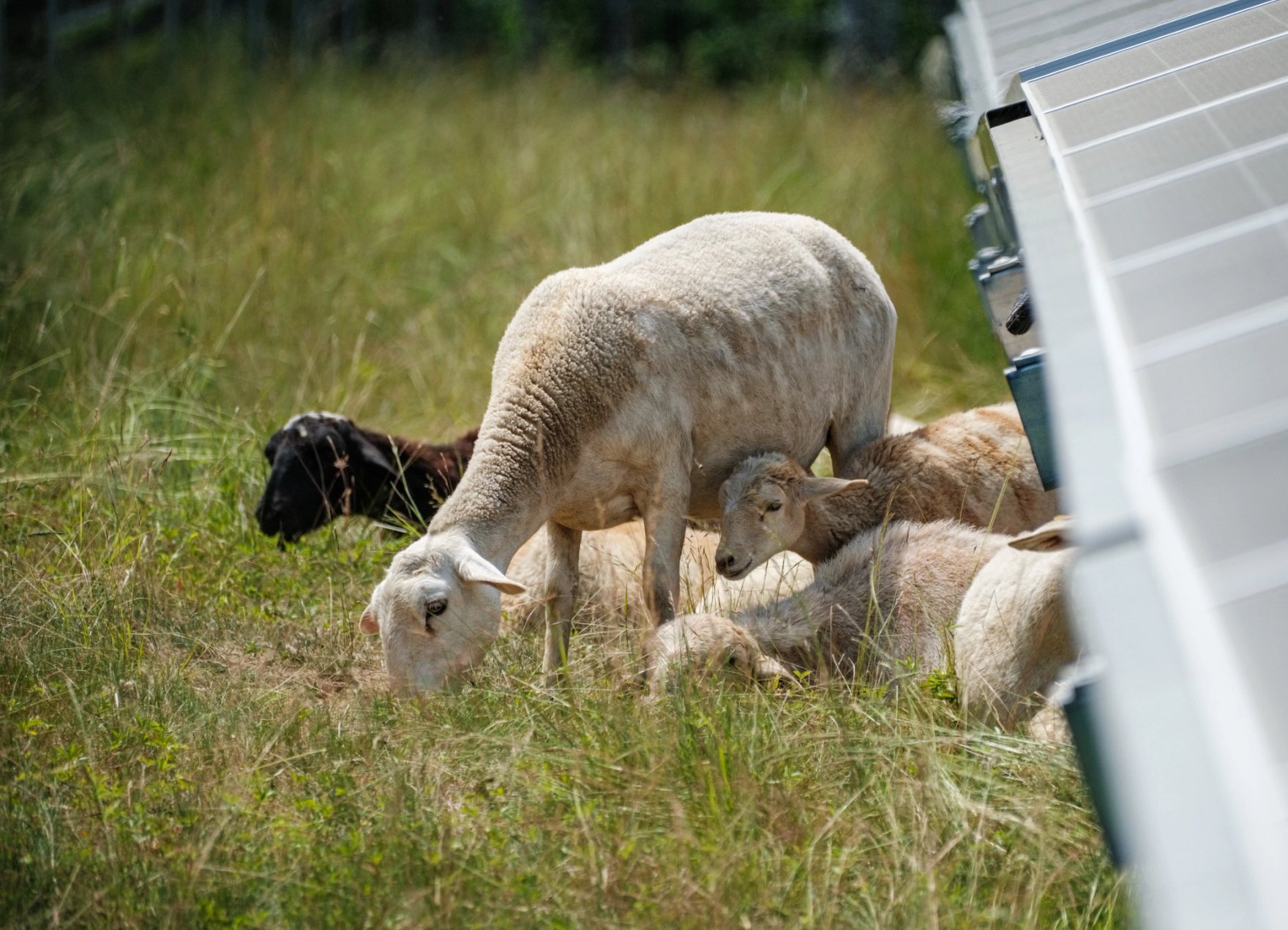
At Nexamp, the term solar grazing has always been synonymous with the sheep we feature on so many of our projects. In fact, sheep are the animals of choice for grazing on solar farms around the country. However, the reality is that Americans eat far more beef than lamb—roughly 60 pounds per person each year, compared with about 1 pound of lamb.
Sheep are a natural fit for solar sites: nimble, manageable, and well suited to moving under and around panels. For years, they have helped us keep vegetation in check while advancing a model that is more environmentally responsible, aligns with our corporate values, remains cost competitive, and creates opportunities for farmers in the communities where we operate.
Now, Nexamp is testing what comes next.
Rebekah Pierce of J&R Pierce Family Farm proposed a cattle-grazing pilot at Covington Solar 1 and Covington Solar 2 in Fort Covington, New York. The pilot began in June with five cattle—a mix of Aberdeen, Red Angus, and Black Angus, including four heifers and one bull.
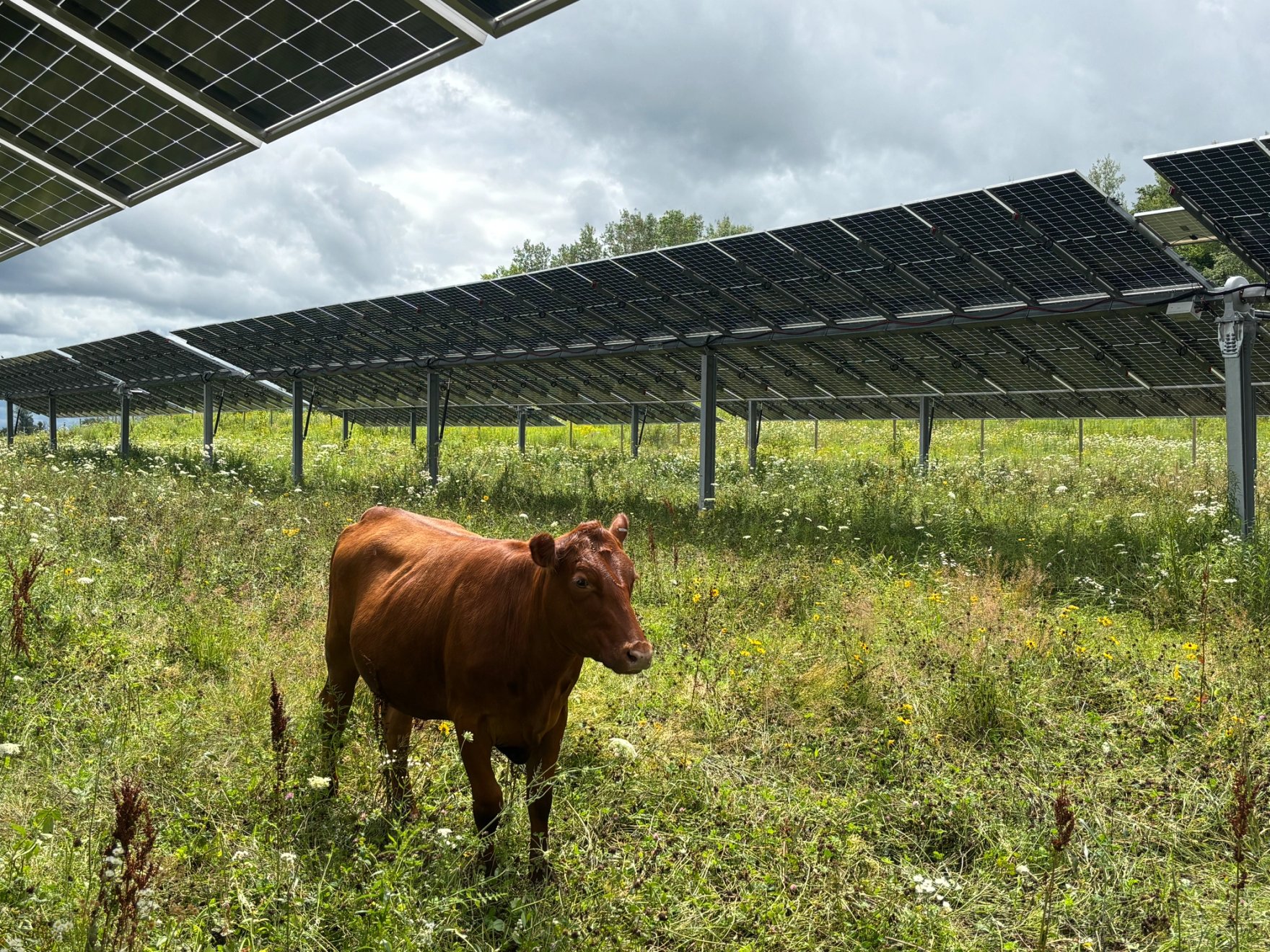
“This breed has some Aberdeen genetics, so their smaller frame was part of what made us curious,” Rebekah said. “But as we got further into the pilot, we realized that breed was far less important than disposition.”
The cattle completed a full rotation across both sites and then moved off to allow the pasture to rest. According to Rebekah, they showed no unusual behavior while grazing under solar, and they did not appear to interact with the panels or other site components. “It went extremely well,” Rebekah said. “They did an excellent job of knocking down the vegetation and seemed comfortable on site.”
For Rebekah, the pilot is about more than just trying something new. It is about understanding how different animals can serve different agricultural needs at solar sites.
“Solar grazing isn’t anything new,” she said. “It’s been done in Europe for decades. But here in the United States, it took off quickly, with the number of solar graziers doubling between 2020 and 2024.”
Sheep remain the most flexible option for solar sites, especially those not designed with agricultural dual use in mind. But Rebekah sees cattle as part of a broader evolution.
“We’ll always graze sheep on solar sites,” she said. “They work great on sites that weren’t planned with agricultural dual use in mind. And we’re sheep farmers at heart. But we also recognize that there’s a huge demand for local, affordable beef. And we want to help fill it.”
That demand is real. While lamb has a place in the market, Americans consume far more beef than lamb. J&R Pierce Family Farm has raised beef since 2022, but this is the first season their cattle have grazed solar.
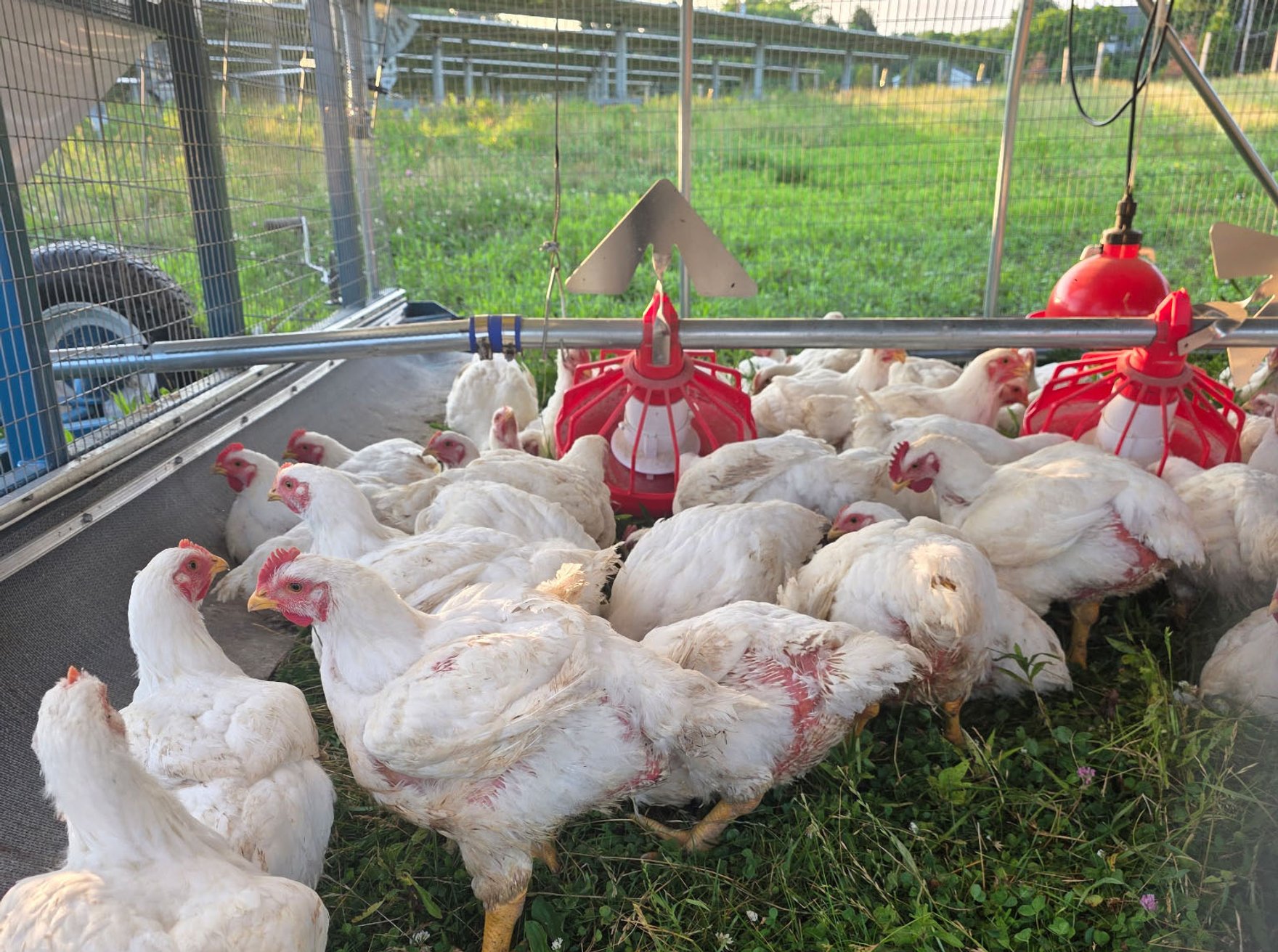
The pilot also reflects a broader shift in how solar grazing is being discussed. Sheep proved that livestock could play a practical role in land stewardship at solar sites. Pigs expanded the conversation further. In the summer of 2023, Nexamp tested grazing with Kunekune pigs and young Idaho Pasture Pigs at our Lansing Solar site in partnership with grazier Caleb Scott. It was a success, and Caleb continues to graze pigs there. This year, he also added chickens to Lansing, while still using pigs and sheep on site.
Each new experiment teaches us something different. With cattle, one of the early lessons is that size matters less than disposition.
Calm cattle that are comfortable with frequent handling, rotational grazing, and electric fencing may be especially well suited to solar. Rebekah believes that animals already accustomed to being moved regularly and managed closely are more likely to thrive in this setting.
That insight matters because the goal is not simply to prove that cattle can graze under solar. It is to understand which animals, management practices, and site conditions make the model work best over time.
“We’re learning that the individual animals and their ability to be handled and managed well is probably a bigger part of the equation,” Rebekah said. “And that’s something we’re trying to give more credit to as we plan for the future.”
No matter what you call it—agrivoltaics, lambscaping, cattlevoltaics—the goal is the same: keep solar farms productive while putting the land beneath and around the panels to meaningful agricultural use.
Agriculture has always evolved through experimentation, and solar grazing is no different. We’re proud to keep testing what’s possible—and to do it in a way that supports cleaner land management, stronger local food systems, and a more resilient agricultural future.