
%20--%3e%3csvg%20version='1.1'%20id='Layer_1'%20xmlns='http://www.w3.org/2000/svg'%20xmlns:xlink='http://www.w3.org/1999/xlink'%20x='0px'%20y='0px'%20viewBox='0%200%2030%2029'%20style='enable-background:new%200%200%2030%2029;'%20xml:space='preserve'%3e%3cstyle%20type='text/css'%3e%20.st0{fill-rule:evenodd;clip-rule:evenodd;fill:%23FFFFFF;}%20%3c/style%3e%3cg%20id='Symbols'%3e%3cg%20id='Footer'%20transform='translate(-468.000000,%20-360.000000)'%3e%3cg%20id='Group-5-Copy'%20transform='translate(468.000000,%20360.000000)'%3e%3cpath%20id='Fill-1'%20class='st0'%20d='M17.1,26.8h9.3c0.2,0,0.4-0.2,0.4-0.4V2.6c0-0.2-0.2-0.4-0.4-0.4H2.6c-0.2,0-0.4,0.2-0.4,0.4%20v23.8c0,0.2,0.2,0.4,0.4,0.4h12.3v-8.2h-3.3c-0.6,0-1.1-0.5-1.1-1.1s0.5-1.1,1.1-1.1h3.3v-4.8c0-2.3,1.8-4.1,4.1-4.1h3%20c0.6,0,1.1,0.5,1.1,1.1S22.6,9.7,22,9.7h-3c-1,0-1.9,0.8-1.9,1.9v4.8h3.3c0.6,0,1.1,0.5,1.1,1.1s-0.5,1.1-1.1,1.1h-3.3V26.8z%20M26.4,29H2.6C1.2,29,0,27.8,0,26.4V2.6C0,1.2,1.2,0,2.6,0h23.8C27.9,0,29,1.2,29,2.6v23.8C29,27.8,27.9,29,26.4,29L26.4,29z'/%3e%3c/g%3e%3c/g%3e%3c/g%3e%3c/svg%3e)

%20--%3e%3csvg%20version='1.1'%20id='Layer_1'%20xmlns='http://www.w3.org/2000/svg'%20xmlns:xlink='http://www.w3.org/1999/xlink'%20x='0px'%20y='0px'%20viewBox='0%200%2030%2030'%20style='enable-background:new%200%200%2030%2030;'%20xml:space='preserve'%3e%3cstyle%20type='text/css'%3e%20.st0{fill:none;stroke:%23FFFFFF;stroke-width:2;stroke-linecap:round;stroke-linejoin:round;}%20.st1{fill:none;stroke:%23FFFFFF;stroke-width:2.6;stroke-linecap:round;stroke-linejoin:round;}%20%3c/style%3e%3cg%20id='Symbols'%3e%3cg%20id='Footer'%20transform='translate(-568.000000,%20-360.000000)'%3e%3cg%20id='Group'%20transform='translate(569.000000,%20361.000000)'%3e%3cpath%20id='primary'%20class='st0'%20d='M20,22v-4.8c0-1.8-1.3-3.2-3-3.2l0,0c-1.7,0-3,1.4-3,3.2V22'/%3e%3cpath%20id='primary-2'%20class='st0'%20d='M26.4,28H1.6C0.7,28,0,27.3,0,26.4V1.6C0,0.7,0.7,0,1.6,0h24.9C27.3,0,28,0.7,28,1.6v24.9%20C28,27.3,27.3,28,26.4,28z%20M7.8,14v7.8%20M14,17.1V14'/%3e%3cline%20id='primary-upstroke'%20class='st1'%20x1='7.8'%20y1='8.5'%20x2='7.8'%20y2='8.1'/%3e%3c/g%3e%3c/g%3e%3c/g%3e%3c/svg%3e)
Pollution from single-use plastic has become one of the most pressing environmental issues of our time. And in today’s world, it seems like there is more plastic on our shorelines than ever before. Plastic Free July is the month-long event that asks us to focus on ways we can reduce single-use plastic in our everyday routines. Although each of us is but a drop in the ocean, together, we can set off a ripple effect with a worldwide impact. Here are few ideas you can follow to help fight plastic pollution:
Reusable Water Bottles
From the production of single-use plastic bottles to where they’ll eventually end up, there’s not much going for them. Investing in a reusable water bottle helps the environment in all the ways single-use plastic harms it. They use less oil when it comes to production, release less CO2, and they’re good for water in general. It’s a no-brainier!
Package Free Shower Products
Choose to refuse single-use plastic bathroom products. There are a number of brands that supply shampoo, conditioner, soap and more in bar form, without any packaging materials. One study discovered that plastic liquid soaps require about 20 times more energy for packaging production than bar form soaps. By going plastic-free with your bathroom products, you are contributing less to plastic pollution.
use less oil when it comes to production, release less CO2, and they’re good for water in general. It’s a no-brainier!
Ditch Single-Use Plastics
Single-use plastics, such as straws, utensils, and food containers, are used for mere minutes before becoming waste that can persist for hundreds of years. Replace them with sustainable alternatives. Invest in a set of reusable utensils made from bamboo or stainless steel, carry a stainless-steel straw, and opt for reusable food containers. By making these small changes, you can significantly reduce your plastic footprint.
Make Conscious Food Choices
Plastic waste is also associated with our food choices. When grocery shopping, try to choose products that are not wrapped in plastic. Opt for fresh produce instead of pre-packaged options. Consider making more meals from scratch to reduce reliance on packaged convenience foods. Buying local, seasonal produce can also help reduce the carbon footprint associated with transportation and packaging.
Food Storage in the Kitchen
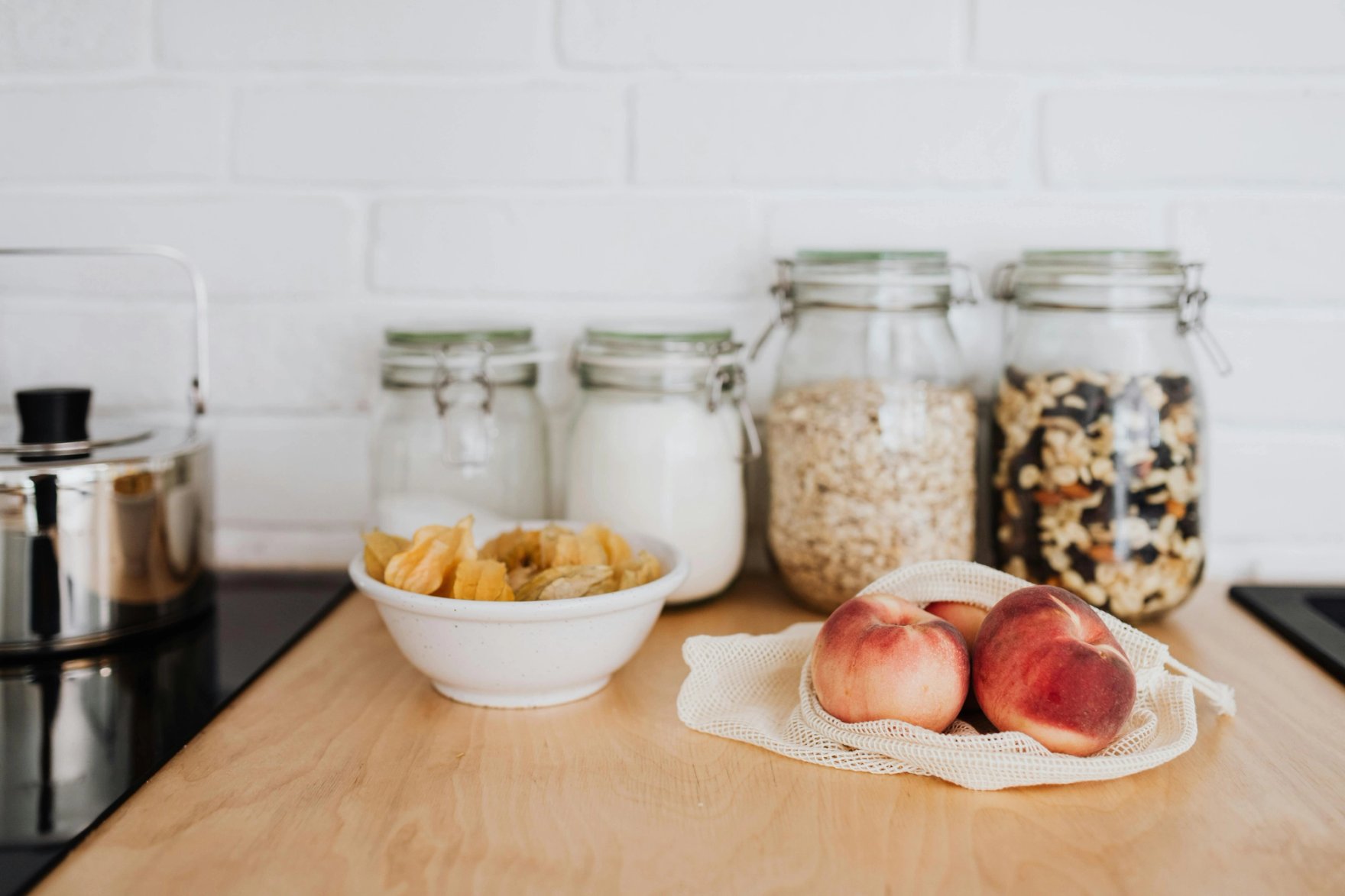
Food storage remains the biggest challenge for most people, as so much comes wrapped and packaged in plastic without any alternative. Very frustrating! Instead, you can create a beautiful pantry by washing and reusing glass jars you already have at home; peanut butter, jam, olives, pickles…they all come in glass jars! Instead of tossing them into the recycling bin once empty, use some rubbing alcohol to get the sticky labels off. A marker and some creativity will do the rest and there you have it: beautiful containers to be re-filled with pasta, nuts, flour, etc.
Reusable Cutlery
Plastic cutlery is used for only a few minutes but they take centuries to disappear and break up in tiny particles also known as micro-plastics, polluting our oceans and harming marine life. Refuse single-use cutlery when ordering takeout or at a restaurant and carry your own reusable set! Check out The Package Free Shop for reusable sets.
Plastic Free Dental Hygiene
According to National Geographic, if you laid out the toothbrushes thrown away in the US alone in just ONE year, they would wrap around the Earth FOUR times. Toothbrushes are not recyclable. Most of us will replace around 300 toothbrushes during our lifetime. So, what is the solution? It’s simple – making the change to a more natural product. Bamboo toothbrushes help eliminate plaque, cavities and are 100% biodegradable!
Plastic Free July is a great opportunity to bring awareness to our plastic consumption habits (and maybe find a thing or two we can swap out – for good). Reevaluate your relationship with single-use while spending time closer to home.