
%20--%3e%3csvg%20version='1.1'%20id='Layer_1'%20xmlns='http://www.w3.org/2000/svg'%20xmlns:xlink='http://www.w3.org/1999/xlink'%20x='0px'%20y='0px'%20viewBox='0%200%2030%2029'%20style='enable-background:new%200%200%2030%2029;'%20xml:space='preserve'%3e%3cstyle%20type='text/css'%3e%20.st0{fill-rule:evenodd;clip-rule:evenodd;fill:%23FFFFFF;}%20%3c/style%3e%3cg%20id='Symbols'%3e%3cg%20id='Footer'%20transform='translate(-468.000000,%20-360.000000)'%3e%3cg%20id='Group-5-Copy'%20transform='translate(468.000000,%20360.000000)'%3e%3cpath%20id='Fill-1'%20class='st0'%20d='M17.1,26.8h9.3c0.2,0,0.4-0.2,0.4-0.4V2.6c0-0.2-0.2-0.4-0.4-0.4H2.6c-0.2,0-0.4,0.2-0.4,0.4%20v23.8c0,0.2,0.2,0.4,0.4,0.4h12.3v-8.2h-3.3c-0.6,0-1.1-0.5-1.1-1.1s0.5-1.1,1.1-1.1h3.3v-4.8c0-2.3,1.8-4.1,4.1-4.1h3%20c0.6,0,1.1,0.5,1.1,1.1S22.6,9.7,22,9.7h-3c-1,0-1.9,0.8-1.9,1.9v4.8h3.3c0.6,0,1.1,0.5,1.1,1.1s-0.5,1.1-1.1,1.1h-3.3V26.8z%20M26.4,29H2.6C1.2,29,0,27.8,0,26.4V2.6C0,1.2,1.2,0,2.6,0h23.8C27.9,0,29,1.2,29,2.6v23.8C29,27.8,27.9,29,26.4,29L26.4,29z'/%3e%3c/g%3e%3c/g%3e%3c/g%3e%3c/svg%3e)

%20--%3e%3csvg%20version='1.1'%20id='Layer_1'%20xmlns='http://www.w3.org/2000/svg'%20xmlns:xlink='http://www.w3.org/1999/xlink'%20x='0px'%20y='0px'%20viewBox='0%200%2030%2030'%20style='enable-background:new%200%200%2030%2030;'%20xml:space='preserve'%3e%3cstyle%20type='text/css'%3e%20.st0{fill:none;stroke:%23FFFFFF;stroke-width:2;stroke-linecap:round;stroke-linejoin:round;}%20.st1{fill:none;stroke:%23FFFFFF;stroke-width:2.6;stroke-linecap:round;stroke-linejoin:round;}%20%3c/style%3e%3cg%20id='Symbols'%3e%3cg%20id='Footer'%20transform='translate(-568.000000,%20-360.000000)'%3e%3cg%20id='Group'%20transform='translate(569.000000,%20361.000000)'%3e%3cpath%20id='primary'%20class='st0'%20d='M20,22v-4.8c0-1.8-1.3-3.2-3-3.2l0,0c-1.7,0-3,1.4-3,3.2V22'/%3e%3cpath%20id='primary-2'%20class='st0'%20d='M26.4,28H1.6C0.7,28,0,27.3,0,26.4V1.6C0,0.7,0.7,0,1.6,0h24.9C27.3,0,28,0.7,28,1.6v24.9%20C28,27.3,27.3,28,26.4,28z%20M7.8,14v7.8%20M14,17.1V14'/%3e%3cline%20id='primary-upstroke'%20class='st1'%20x1='7.8'%20y1='8.5'%20x2='7.8'%20y2='8.1'/%3e%3c/g%3e%3c/g%3e%3c/g%3e%3c/svg%3e)
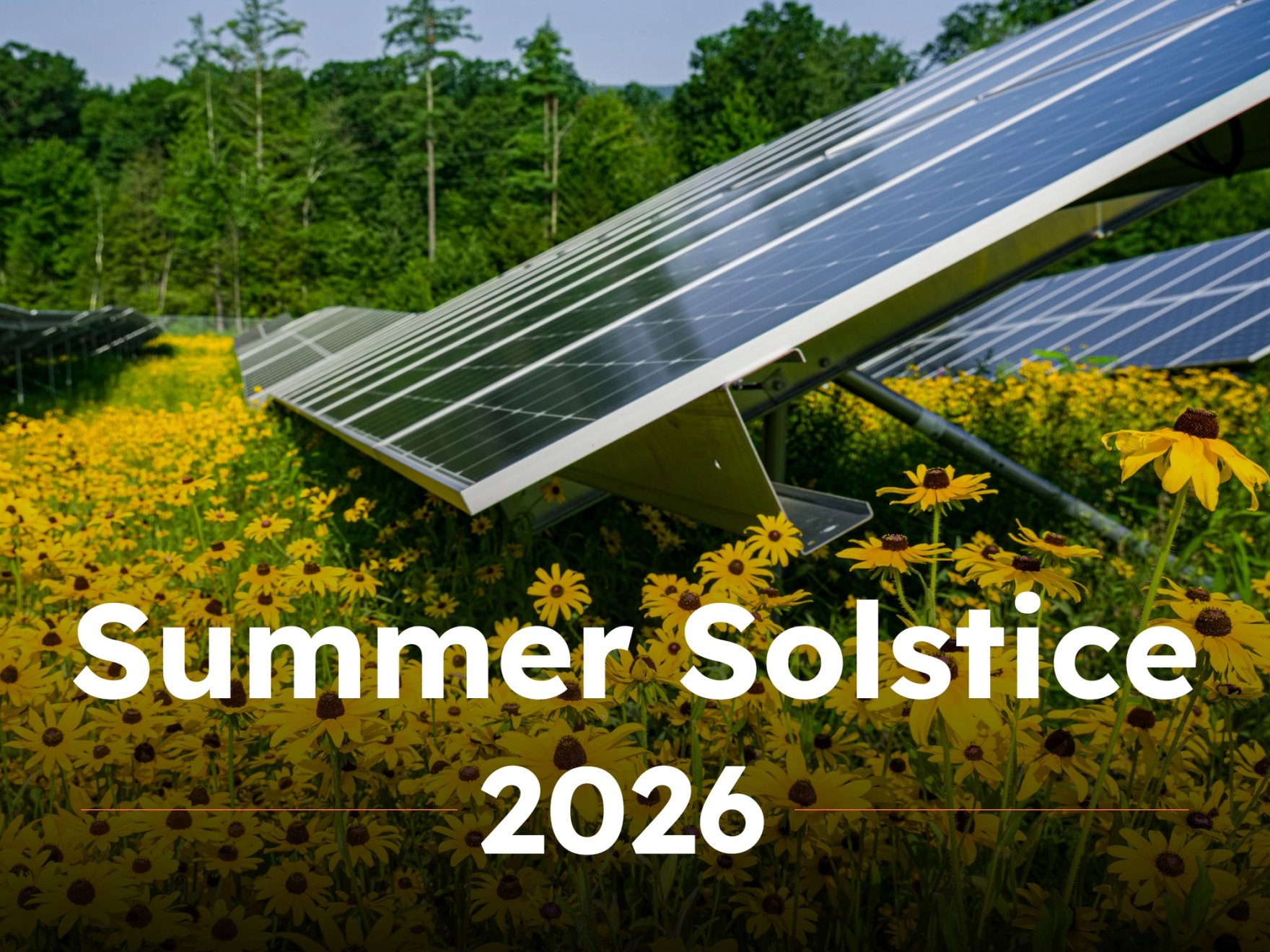
The longest day of the year has arrived. While many people associate the start of summer with Memorial Day weekend, astronomical summer begins with the summer solstice. In the Northern Hemisphere, the summer solstice occurs when the sun reaches its northernmost point in the sky, resulting in the most daylight hours of the year. This year, the solstice fell on June 21st.
Here are four fascinating facts about the summer solstice.
1. What is Summer Solstice?
The summer solstice has been observed and celebrated for thousands of years. Ancient cultures carefully tracked the sun’s movement across the sky, the changing length of daylight, and the shifting locations of sunrise and sunset. Many historic monuments around the world were designed with the solstice in mind.
The summer solstice occurs because of Earth’s axial tilt as it orbits the sun. In 2026, the summer solstice took place on June 21 at 4:24 a.m. Eastern Time, marking the official start of summer in the Northern Hemisphere.
2. The Longest Day Doesn't Mean the Hottest Day
If the summer solstice brings the most daylight, why isn't it also the hottest day of the year?
The answer lies largely in Earth's oceans. About 71% of Earth's surface is covered by water, which absorbs and stores heat more slowly than land. Because the oceans take time to warm up, they continue absorbing heat even after the solstice has passed.
This seasonal lag means temperatures typically peak several weeks after the longest day of the year, often in July or August.
3. What Happens to the Southern Hemisphere?
While the Northern Hemisphere welcomes summer, the Southern Hemisphere experiences the opposite. The June solstice marks the first day of winter and the shortest day of the year south of the equator.
This seasonal contrast is caused by Earth's 23.5-degree tilt. During the June solstice, the Northern Hemisphere is tilted toward the sun, while the Southern Hemisphere is tilted away from it.
Interestingly, Earth is actually near its farthest point from the sun during Northern Hemisphere summer. Seasonal temperatures are driven primarily by Earth's tilt—not its distance from the sun..
4. Summer Solstice and Solar Energy
The summer solstice brings earlier sunrises, later sunsets, and more daylight hours. For generations, it has been a time to treasure the longer daylight hours and warmth that this astronomical event brings us.
Long summer days are also important for solar energy production. As sunlight increases, our solar farms can generate more electricity. Just as energy use changes throughout the year, solar production varies seasonally based on available sunlight.
Summer months typically feature more sunlight that generates a higher level of solar credits to help offset a community solar subscriber’s electricity cost. May, June, July and August are the peak months for many of our solar farms because the sun is higher in the sky and the days are longer.
Now that summer has officially begun, whether you're spending time outdoors, visiting the beach, or simply enjoying a later sunset, take a moment to appreciate the powerful role the sun plays in our daily lives. From powering our planet's natural rhythms to supporting a cleaner energy future, the sun's impact reaches far beyond the longest day of the year.